Showing posts with label feminism. Show all posts

Saturday, April 18, 2015

three different presentation/papers three sequential days. brow wipe. sigh

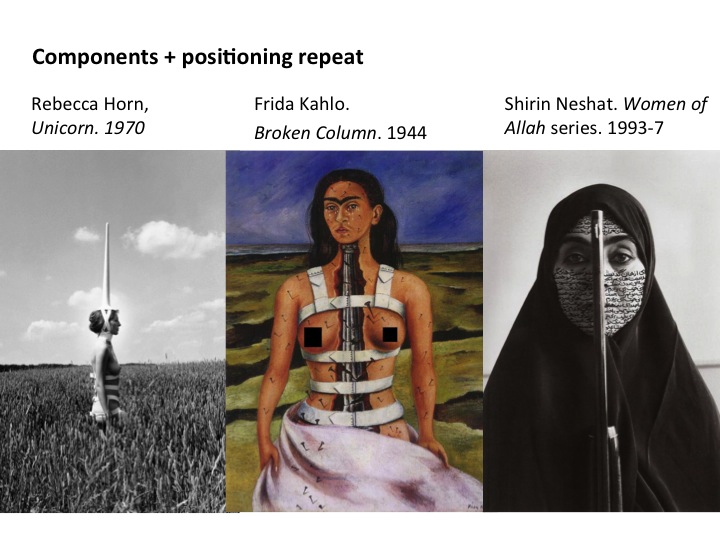
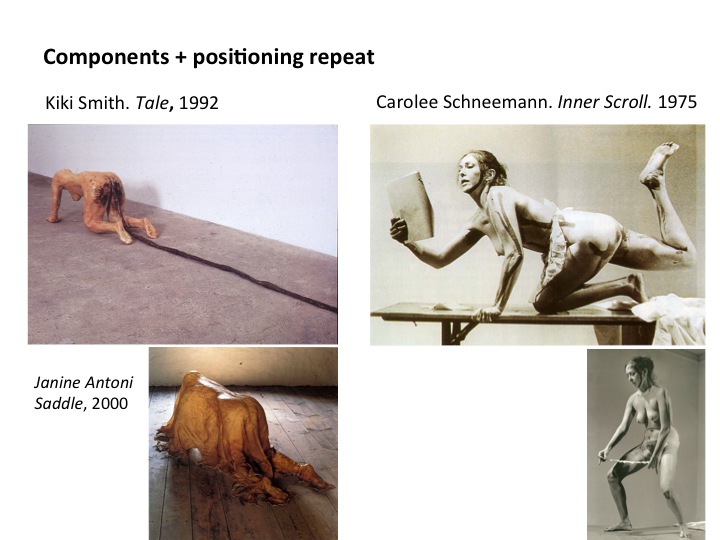
two of the three went well. the third i got bogged down, distracted a stymied on the conference's old laptop, finding the buttons and touch pad clumsy. sigh. next time i just break the rules and plug in my mac. then i can not only run my presentation from my phone and stand anywhere, but can also see my notes simultaneously! my presentations are typically dependent on visuals, they actually provide unsaid information, now they also include key stats, which in my mine, numbers are better seen than said.

here is partial sampling of my three on three. remember you are not getting the verbal commentary, just a half snippet. PS I love Janine Antoni, Robert Morris, and Schneeman's work. How could they not be freaking influential on my primary practice. PSS I am not a historian, but a practicing studio artist, plus grad student, and I teach/present from this perspective.

in the written text of female visual artists are there linguistic traces of self-limiting social positioning?


Robert Morris | agile evasion of disciplinary definition = transgenred


the body is never neutral, never silent [contemporary art history]


 ps. disclaimer - imagery was used for educational purpose in educational setting. outside of a grade, honoring, and self-respect, there was no fiscal benefit.


Wednesday, May 01, 2013

Not once did I ever bore an art historian in grad school in spite of my failure to comply with MLA standards! Revisiting old writings and laughing at Greenberg's great Pea-ness.
what was I thinking? Bahahaa.

I contemplate developing time to start writing about art again. I need to direct my writing more purposefully. Why? Besides because I need it for myself my writing is highly accessible, funny, and educated. I am not always funny, but I always take a stand, and that is funny cause frankly it is just art. Ha!

excerpt from The Formal | Cunt Positive | Bad Painting essays by Kathryn Kelley, 2007. Written in response to three questions proposed by Dana Padgett on Greenberg, Feminism, and Bad Painting in an Art History Post Modern course.

Clement Greenberg’s views on Modern art can be summed up in his eating habits. Imagine the round white disc of the dinner plate sitting in front of Greenberg— gravyless mashed potatoes neatly stacked to the left, tightly corralled green peas on the right, low and central on the plate a bland pork chop (oops, not pork) filet of fish. Most assuredly, Greenberg carefully compartmentalized this meal, breaking it down into the most elemental groupings, never allowing his food to become co-mingled or touch. Each item would remain independent of the others; each basking in its own uniqueness and being most palatable in its pure form. For instance, a pea would lose value if it became embedded in the potatoes or mixed with the fish. The pea should be valued for its innate structure of being a pea. This formal structure was to be fully explored—the surface, the shape, and the properties of its pigment. The pea should justify itself; render itself pure by making explicit that which was irreducible about it. The pea should avoid anything that called up associations with potatoes or fish. Then Greenberg, with great authority, could speak and write to the power of the pea. He would stand tall and firm and promote his formal view of the modern pea. The pea would justify the pea in the same way that logic established logic or paint, the painting. All other foods would fall by the way side and he would proudly tout this pea-ness. It would simply be the pea-ness for pea-ness’ sake. Simply substituting the pea for painting reveals truths and fallacies in Greenberg’s theories of Modern Art. As far as I am concerned the story of the pea sums it up, but, since you need to know that I know what you expect me to know, I shall set silliness aside and connect some of the peas...read the rest [pdf]