Showing posts with label nonfiction. Show all posts

Sunday, May 03, 2015

Mondrian White on White Pivotal Set, Oompa Loompas, A Buzz and Holler, plus Racks of Disemboweled Cadavers. LOVELY

Texas Tech's Mother Courage, April 29 First Performance A slanted critical review of sorts 


As I squirmed in my seat for three hours, fifteen minutes, my anticipation and pleasure resided in what occurred between scenes, which began each time with a buzz, and holler that activated Oompa Loompas to reposition the set. Providing mid-scene intrigue were the racks of disemboweled cadavers with their dangling entrails.


The white portable set (below. figure 1) was like modernist geometric painting including extreme color reduction. It called to mind Kazimir Malevich’s 1918 painting, White on White (figure 2), and his contemporary’s, Piet Mondrian, paintings and spatial forms (figure 3). The play’s set was modularly built into columns with 4x4 footprints and heights ranging from 10 to 16 feet. Though not visible, their base included wheels, allowing for quick almost Tetris-like repositioning. Each column included a door-sized passage, but like the wheels, they were kept out of audience view. The interiors were lined with white non-reflective fabric so if per chance the passage were slightly exposed to the audience, it would go unnoticed. These passages functioned to hide stagehands that would mid-scene provide characters with prop and mics.

figure 1: set detail
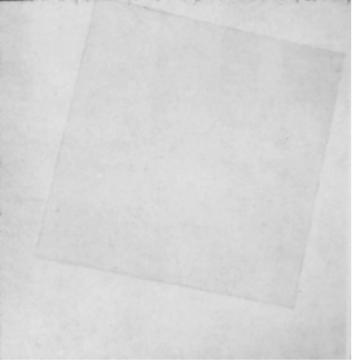
figure 2: Malevich, White on White

figure 3: Mondrian

The neutral white and geometric simplicity diminished scenic distractions so that the plays action was perceptually foregrounded. It also reduced the need and risks in replication or accuracy of the temporal and geographical setting. In fact, it decontextualized the play from the early seventeen hundreds scripted setting. The only ground to situate the viewer in the temporal location was the design of the costumes and key props.

In the decontextualized space, the repositioning of the columns indicated scene changes. With each shift, various flat panels, reminiscent of the columns’ Mondrian-like surfaces, were lowered from the ceiling to further reshape the space, as a sign to cue scenic change. The transitions were made in full audience view. Despite the physical repositioning, it was each scene’s action that dictated how the space should be interpreted—pub or pasture, day or night, plus indicating Mother Courage’s migratory habit. I found the set and its repositioning aesthetically soothing. It counterbalanced the emotive connotations associated with theatrically required projections of voice and gesture.

The play would have been significantly served by decontextualizing it beyond just the white set to release its primary read from being tethered to seventeen hundreds. Converting all the costuming and props to white with the exception of each characters vest, sash or a single item of distinction, while maintaining their antiquated design, would have effectively diminished the chronological anchor. This would have emphasized the characters’ actions and script in ways that would transcend the time period becoming more applicable for today. It would correlate the plot in terms of our own cultural and global climate with its dragged out “incursions,” leftovers of our War on Terror, and other political interventions. Only in unpacking the play for this paper has the probable intention of the director’s selection of Mother Courage revealed real correlations.

Raytheon, a weapons guidance system corp, is a most profitable stock. I shall neither confirm nor deny that I may own some. Perhaps it has even assisted in temporarily freeing me to pursue my PhD. Am I equally complicit and compromised by the benefits of war, as Mother Courage was? Do I stand on carcasses of others as I reach for yet another degree? Had the play more clearly de-tethered from its historical fix, I would have arrived at the uncomfortable position that reveals me as part of our contemporary war economy. This would have been quite poignant because it would turn my harsh judgment of Mother Courage around on myself. I like to be unsettled, moved from my willful blindness and American arrogance. I wish the play itself had done this for me, it did not. I maintain my buffered ego and denial. Plus perhaps  I also bought Tesla stock when it first hit the market. Ha. Apparently, I am into clean energy and bombing, just call me Mother Courage.

It would be perfect to end this post at the last line, but then I would have to re-title it. I ramble on with the review for class criteria hoop jumping and to get to the Oompa Loompas, the play’s best part ☺. But first a little more on the set. The drop down paintings as contextual staging were problematic. The only painting that assisted the play in terms of progressing the story was the replica of Goya’s painting, May Third. The first and last paintings where exceptionally disruptive—perceptually fixating. The first glowed neon orange—visually eye riveting, screaming. The last was a gargantuas muddy brown blob OZ head. Its scale made it impossible to ignore. I assume, though unrecognizable to me, it referenced a historical painting, but it was just shit ugly and distracted me from the story.

On the other hand, I loved the clothes racks packed with cadaverous heads and their disemboweled torsos with dangling entrails. Then again, perhaps I own Raytheon stock. Sigh. In a manner, the cadavers correlated with the staging in that they decontextualized the play from the “real” and its temporal location in history. The clothing store-like racks linked the story to contemporary culture, perhaps pointing to the costs of our consumer-based economy. I appreciated the way the abstraction and repetition suggested the horrors and carnage of war with the multiple racks signaling ongoing death counts.

The acting and singing left me wanting. As fine an actress as Mother Courage was, she was not even remotely my favorite character. The very best thing about the play was the Oompa Loompas, apparently recast from Willie Wonka and the Chocolate Factory. Though neither short nor bearded, they dressed hygienically, donned in all white paper industrial-like coveralls, including white foot booties that muffled the sound of their walking. They functioned between scenes, just as they did in the movie when cued by Wonka and set to the task of scene transition by rolling off the Blueberry Girl for squishing or the other "bad" children for obvious consequences.


Likewise, in Mother Courage, a buzzer, followed by a holler, “scene change,” activated the scenic inbetweens. The Oompas moved silently with calculated intent as they danced the white columns to new positions. It was just freaking beautiful. The music played softly in accompaniment, but I was so fixate on their coordination and efficient movements it really didn’t register. I would have been happy with three hours of that or at least twenty-two minutes. In either case, I would need a hint of a conceptual intent. Seriously, I might have preferred the play’s narrative without bodily action. With the characters garbed in white costume, proplessly standing behind a series of white podiums, lined up in a row, voicing their lines. And then holding still and silent as the Oompa Loompas, initiated with the buzzer and pre-emptive holler, “scene change,” did their thing. Even with unaltered script, this would have teleported the viewer from the past to the future of now. Oh, I would have been so engaged. Sometimes “less is more” though that would require a butt-load of risk and courage.

Ha, and would the Oompa Loompas songs be relevant to Brecht’s script? I think so. It is worth a test, in creating a new version of Mother Courage worth doing.


NOTE: Perhaps interdisciplinary in development, Mother Courage seemed to fit my stereotype of conventional three parts play and one part musical.

Tuesday, January 27, 2015

abstraction and ambiguity -- two magnets, one mom and a refrigeratordoor -- take three

If you follow me much, than you know I hide behind ambiguity and abstraction. This is true for my work that inhabits both real (art) and cyber space (blogged writings)--by god I stitch with tie wire self referential forms from dilapidated combine tubes. I hide in plain sight. I stand stripping naked yet rarely exposed...well, unless you've read my entire freaking blog and intuitively fill in the emptied nail holes (read between the lines) I've left behind. Those of you that push the putty, fill the holes, hear the humor in my own piddley passage. I think eventually you find some ground from which to see me. Pretty sure you do.

Buttttt. As always I have a big (somewhat skinny) but. And that but is that I'd like to be hintfully more clear. So I sit in a creative nonfiction graduate workshop grappling with my big but. I bite my lip in retort, post oral class reading. It seems so blatantly clear to me...alas...this is definitely not the first time I've run into my own big butted ambiguity and abstraction...

Sigh.
Yup, in elementary school I was always circularly corralled in the dumb oral reading groups. Gosh, even I knew the why for the way words twisted off my lips [then as now], my cheeks burned cherry red, and all cognitive conceptions canceled. Even the former, two and a half decade long, legal love unit was perpetually shocked and mildly mocked my blatantly blabbed butchery. I remember multiple sullen Saturday morns when he trudged next to me trying to break a part "especially." It simply would  do nothing but mutate in its roll from my tongue. And he'd repeat -- Eeeee. Spesh. Aaa. LEE. Eeeee. Spesh. Aaa. LEE. No, really Kathy! I was thirty three. Sigh. Eeeee. Spesh. Aaa. LEE. Especially. Finally now, today, unmalformed it flows as the unit strolls by in my head as I go  Eeeee. Spesh. Aaa. LEE. Ha. 
Oh yes, I did flunk sophomore "Five-Hundred Word Theme" with a forty-seven, repeated again for a C. Dormed and degree bound, first one, I was stuck in remedial writing--same freaking textbook I survived with an F then a C. OMG. I deferred my remainder, English courses that is, to the end, hoping I might be raptured before then. Dang my unrapturedness.  
A decade later, hired as director of communication, I explained that I might edit BUT would not write. I would not write. I was clear. Of course, I also told them I would not wear a dress either. I’ve quite a few big buts. 
So I find it infinitely humorous on degree three, that at least three art historians, really, one, two, three--Brauer, Padget, and Jacobs--suggested I had a knack to write and criticize. Head that direction. Ha, the blatantly blabbed butchery bound to each page was simply ignored, for the compression of critical content couched in hidden humors they got. A, A, A, A, A, A, A, A and another. I contemplated degree four in writing and critical theory.  Five seconds then done. I was tribe bound with a legal love unit, so that was to be ignored. Hugh. Huh. Hmmm. Welp, here I am. 
Now sans one legal love unit, I write with little shame. But, but, BUT could I just be a tad more freaking textually clear?!

That said, here is rewrite three in which I try to ground my ungrounded graduate reader, post my oral presentation. Next week I’ll do a re-right again, trying to work further around my big ambiguous but that blocks my way.

--- Draft three ---

Two magnets, one mom and a refrigerator door
Your eyes shift down from their low casting across the long table’s surface to the one with blush burned cheeks. With eyes averting, you wait for something small, something smart, worth the wasted while. Waiting. Waiting. My cheeks burn all the more in the stalled stretching span. The words on the page coarsely twist off my lips. Stupidity overwhelms me in that first unrecoverable instance.

My nose flares with a frustrated hmmph. In fact, there are no words on the page to twist off my lips, and you, you, and you, with your already penned publishes, gathered here in round three of each of your piling up English degrees, have yet to sit.

Hunched over my desk, I look to my right. I hesitate, hating that damn black bulldog clip thingy. It sits silently clasping itself, clinging impotently and unused to my wall mounted magnetic strip. Waiting, I calculate and cull from Paper Clips, Sausage, Candy Cigarettes, Silk: ‘Thingy-ness’ in Flash Nonfiction—but the black bulldog clip’s thingy-ness remains verbless and voiceless. There is no fusion of form or frame for content or cognition. No muse at all, just a damn mute thingy. It watches me subjectlessly grope my way through the assigned text. I turn the page hoping for more from the next. I stop. I wait. I try not to do smart. Smart is stupid. It stalls me, binding up as yet unwritten moments. I stare empty eyed at that stupidly smart bulldog clip, clamped shut, failing to give voice. I hold there, for a memory of my own, for histories released. I wait; I waffle, like an unmoored blank page a drift to the floor.

And, I mull down on my unwritten, unadmitted, why. That why that planted my ass right here for yet another but final degree. It sits heavy, I try to leverage it to push the pen. Nothing. Instead, I cultivate convincing myself to just freaking mimic the process I forced, a mere forty-eight hours ago, on my drawing students, set with the remedial task of blind contours. Literally positioning each with a laterally outstretched penciled arm, reaching slightly behind them to mark their easeled, bulldog clamped pad. They stare into a stool perched peer’s face, a mere socially inappropriate two feet in front of them, stretching the non-penciled arm forward, finger extended, pointedly poking and tracing the multiple contours of a face not their own. Leaving a mere lead trace, the pencil and padded hand translates with one continuous threading line. So focused, they work until their shoulders’ scream with exerted burn. Arms windmill around the room and then each set returns to their page. The drawings develop; find face in a process not a product. It’s a way of unlearning their cognitively compressed perceptual knowings. One eye large, one small and displaced below the nose, the ear a cheek, the chin so small, the nose laps over the mouth. Each distortedly different—fragility and frustration processed, released. Those that forego fixation on the final outcome, find face. The drawings oddly read as real. On the other hand, those penciled from the cognitively coerced are worth only two magnets, one mom, and a refrigerator door.

My mind returns me to put pen to page in a parallel process, to write. Of course, this is a lie. I thumb my digital device, swiping away my glossed knowings, my false facades and my repetitive reviews of the LIKES on my most recent Facebook update. Hmmmph. I point to the damn convoluting contours of that impotent clip and my mind's eye fingeringly follows my own blind unfaked fragility and frustration with this forced first draft. I feel the residual taint of my own feared stupidity and am left with missing my mom, two magnets and her refrigerator door.

--------------------------------------- 
Funny after drafting this up I find myself reading Alexander Smith, circa 1892, On Writing Essays. Ha, while speaking of the essayist Montaigne, he notes, 
"The essayist plays with his subject, now whimsical, now in grave, now in melancholy mood. He lies upon the idle grassy bank ... letting the world flow past him, and from this thing and the other he extracts his mirth and his moralities... as I walk through the woods... His habit of mind is leisurely; he does not write from any special stress of passionate impulse; he does not create material so much as he comments upon material already existing ... His main gift is an eye to discover the suggestiveness of common things... If you wish to preserve your secret, wrap it up in frankness... He laughs at himself and his reader ... you suspect mockery or banter in his tones. He is serious with the most trifling subjects, and he trifles with the most serious." 
Of course I live in 2015, am female, and at the moment, less than idle. But I miss the idle and speaking to the common place of the moment. I miss laughing at myself and being my own egotistical primary source. ] 
--------------------------------------- 

Two magnets, one mom, and a refrigerator door


Your eyes shift down from their low casting across the long table’s surface to the one with blush burned cheeks. With eyes averting, you wait for something small, something smart, worth the wasted while. Waiting. Waiting. My cheeks burn all the more in the stalled stretching span. The words on the page coarsely twist off my lips. Stupidity overwhelms me in that first unrecoverable instance.

My nose flares with a frustrated humph. In fact, there are no words on the page to twist off my lips, and you, you have yet to sit. I look to my right.

I hesitate, hating that damn black bulldog clip thingy. It sits silently clasping itself, clinging impotently and unused to my wall mounted magnetic strip. Waiting. Its thingy-ness remains verbless and voiceless. There is no fusion of form or frame for content or cognition. No muse at all, just a damn mute thingy. It watches me subjectlessly grope. I stop. I wait. I try not to do smart. Smart is stupid. It stalls me, binding up as yet unwritten moments. I stare empty eyed at that stupidly smart bulldog clip, clamped shut, failing to give voice. I hold there, for a memory of my own, for histories released. I wait; I waffle, like an unmoored blank page a drift to the floor.

And, I mull down on my unwritten party line as to why I am here. It sits heavy, I try to leverage it to push the pen. Nothing. Instead, I cultivate convincing myself to just freaking mimic the process I forced a mere forty-eight hours ago on my drawing students, set with the remedial task of blind contours. Literally positioning each with laterally outstretched penciled arms, reaching slightly behind them to mark their easeled, bulldog clamped pad. They stare into a stool perched peer’s face, a mere socially inappropriate two feet in front of them, stretching the non-penciled arm forward, finger extended, pointedly poking and tracing the multiple contours of a face not their own. Leaving a mere lead trace, the pencil and padded hand translates with one continuous threading line. So focused, they work until their shoulders’ scream with exerted burn. Arms windmill and then return to the page. The drawings develop; find face in a process not a product. It’s a way of unlearning cognitively compressed perceptual knowings. One eye large, one small and displaced below the nose, the ear a cheek, the chin so small, the nose laps over the mouth. Each distortedly different—fragility and frustration released. Those that forego fixation on final outcome, find face. The drawings oddly read as real. On the other hand, those penciled visually and cognitively coerced are worth only two magnets, one mom, and a refrigerator door.

So I put pen to page in a parallel process, but to write. Of course, this is a lie. I thumb my digital device, swiping away my glossed knowings, my stupidly false facades and my repetitive reviews of the LIKES on my most recent update. Hmmmph. I point to the damn convoluting contours of that impotent clip and my mind's eye fingeringly follows my own blind continuity of unfaked fragility and frustration with this forced first draft.

I am left with missing my mom.