Showing posts with label academic textabation. Show all posts

Sunday, June 21, 2015

"research becomes an alternative to further self-cannibalization" - Lopate


to see if I can explore this realm while learning to efficiently navigate a pool and a swim/floating method I haven't previously used. Things I have been thinking about while thinking about if their is a resilience and realization function in the act of writing for the visual artist. gender/power/representation differences in the language of visual artists.


transgenre behaviors and creative dispositions and capacities to push against social conventions.


The artist and the body, perception, embodied/situated/extended cognition. This brings me back to social positioning--visually, bodily, linguistic. Is there anything we do when somehow entering social space that does not involve social positioning?

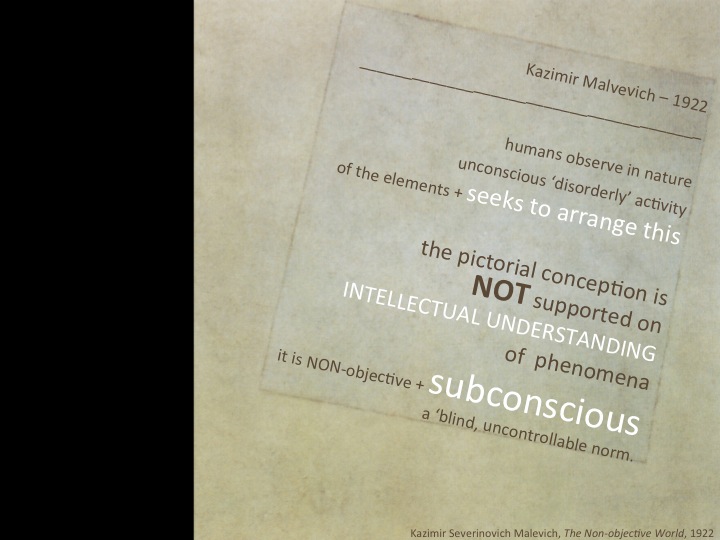
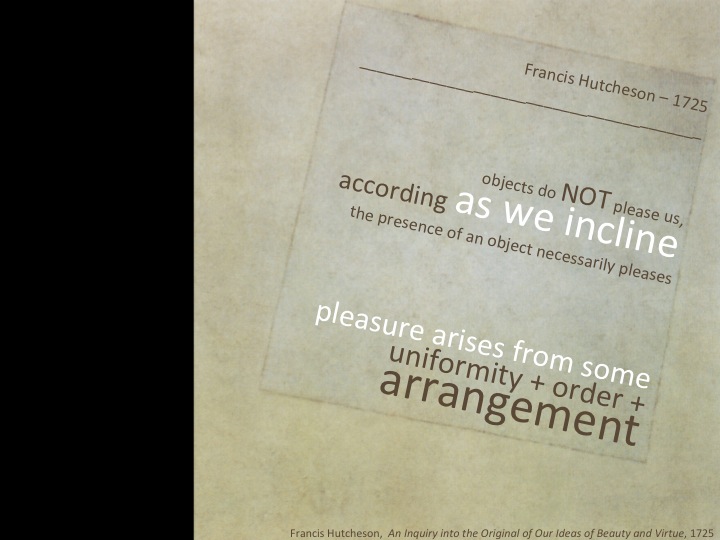
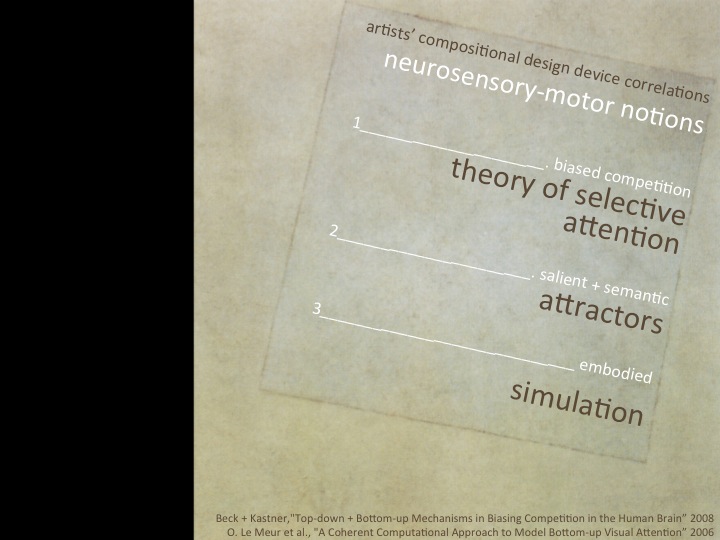
the artist, perception, cognition. not just social positioning, but we position overall stimuli in a fashion that lets us minimize the overwhelming field of possibilities and realities in order to fashion some kind of comprehension which in turns allows us to navigate our physical (social, mental, spiritual, objects, language, encounters, histories, memories) world.
Slide08 Slide04 Slide03 Slide02

looking at my habits of researching a learning is to exploratorily test something, use what catches my attention in the data spitting to direct me to knowledge domains or practices that I need like [in the field of language and social sciences]
  1. Politeness Theories
  2. Appraisal Theories
  3. Gender Theories
  4. Power Theories
  5. Stance
  6. Discursive Analysis
  7. Trauma and health and writing
  8. Resilience
  9. Neurological processes of perception and cognition
  10. Mirror neurons--perception, empathy, language, human behavior
  11. Embodiment
  12. Phenomenology
  13. Cognition, situated cognition, extended cognition, embodiment
  14. Creativity
  15. The list is exhaustive and overwhelming and all informative
  16. and a kazillion other theories as found
And now I am beginning to extend discovering the various social science research qualitative and quantitate methodologies and tools. In each arena I only now have enough understanding to get myself into trouble via false or already overworked assumptions, but sometimes mashing things together without full domain understanding can lead one to stumble on an alternate perspective, new approach, etc, besides just the risk of appearing an arrogant domain neophyte or polishing wheels that already exist. No matter where I turn I keep coming back to stance and social, cognitive, perceptual, and linguistic positioning... What do visual artists write? Is there a vocational, social and cognitive resilience function? Is there a function for realization of work?

For my summer Data Mining course that I have to take the blue pill each week to attend.


PROPOSED PLAY :: The semantics of certainty and insistence in visual artists writings                                                              
Disciplined play privileges experimentation and modeling over hypothesis testing or concordance publishing – Geofrey Rockwell

RATIONALE / JUSTIFICATION
Based on initial patterns that emerged in a quantitative study using LIWC2007 and DICTION7 involving insistence and certainty linguistically expressed in artists writings, I am curious to look more deeply at these variables.

I believe a huge portion of creative activity is reactionary. By this I mean that somehow a particular developmental adversity, situational chaffing, unsettles, resonates or enlivens the artist enough to engage a form of appraisal, judgment or questioning, that is then expressed in artistic production in ways that address, call attention to, resolve, act against, or support the artist’s viewpoint or experience. Linguistic insistence and certainty expressed in writing would also appear to be behaviors in which appraisal/judgment is expressed, a stance is taken. Because most art is reactionary, a form of stance taking, and is what captivates the mind and energy of an artist, 

I expect stance taking to also be statistically evident in their writings.

SO WHAT? WHO CARES? PLAYGROUND in which this current proposal sits
I have a hunch, a hypothesis, that a writing practice somehow plays some kind of psychological resilience function for visual artists relative to their making practice. I associate resilience with the capacity to realize and sustain an artistic/creative practice through one’s life span. If resilience is somehow strengthened by the act of writing, is there a form of writing that is more beneficial? If so what forms are the most supportive?

A secondary hunch is that the act of writing, much as analytic memos in research coding, functions to deepen through insight the content development and making processes that are central to the artists practice.

So as I hunt for patterns of similarity in artists’ writings that might shed light on the possibilities that writing for this visual artist has a psychological function that assists them in realizing and sustaining their art practice, semantics is one field in which to evaluate sample texts. If I am correct that there is an important function of writing for the visual artist and if there are particular forms that are more useful, this has important pedagogical implications in how the academy prepares artists for a life of making.

Additional Questions/Arenas Does the writing for the visual artist have a correlative function with
  1. Bodily cognition functions?
  2. Situated or extended cognition?
  3. Loose sensory gating? [Neurological/Perceptual function]
  4. Psychological function?
  5. Cognitive function?
  6. Social function?
INITIAL RESEARCH QUESTIONS
The linguistic variables of certainty and insistences have already shown up in my previous study with LIWC and DICTION as notable. Will the writings also express strong sentiment or will they be emotionally neutral? Will there be correlations of linguistic cues of sentiment, specifically positive, negative or neutral with certainty and insistence?

And as always in my work as an ongoing curiosity, are their notable gender differences?
A visual stance (art making) involves a bodily response to materials and space; a cognitive stance is expressed through linguistic space internally or externally. Will these be mirrored in artifacts and text emerging from a single author/maker? Will this mirroring be evident in most visual artists’ writings?

FIRST BLUSH
My initial gut response is that visual artists’ writings will bear strong sentiment, positive or negative, with very little content in the neutral zone.

[CERTAINTY + INSISTENCE = +/SENTIMENT] 
[LOW CERTAINTY + INSISTENCE = NEUTRAL SENTIMENT]

I also expect from artists working in the last sixty years, since conceptual art became prevalent, that much of the sentiment will be negative. Most artistic production arises from reactionary resistance against some cultural practice, personal adversity or x.

[SENTIMENT > NEGATIVE]

Though historically and philosophically beauty plays a role in art, it does not play a strong role in contemporary avant-garde art for the past one hundred years. Art and the artist function as a cultural barometer more so than producers of beauty.

These hypothesis, hunches, mental maulings and assumptions suggest that I might approach the artists’ texts via systems that test for sentiment and/or conflict (versus coding).

Additionally it seems relevant to begin establishing a system for attribute coding (as suggested in Saldana’s text) which may reveal similarities and differences in artists texts that correlate with gender, primary medium, career stage, education, age, ethnicity, orientation, affluence, etc.

SECOND BLUSH
Specifically what comes to mind is that fact that when I am uncertain, I may be more emotionally reactive or frustrated, and when I am more certain, I emotionally relax. So I see at least two outcomes that would counter my aforementioned hypotheses. One, there is the possibility that I will see the exact opposite results than my initial hypotheses in that artists who express linguistic certainty and insistence will display minimal, neutral, evaluative emotion. Two, that a positive or negative sentimentality will be more related to essays strong in insistences and neutrality with texts that showed a strong sense of certainty.

[CERTAINTY + INSISTENCE = NEUTRAL SENTIMENT + LOW CERTAINTY + INSISTENCE = +/- SENTIMENT] OR [if CERTAINTY is dominant = emotionally relaxed; NEUTRAL SENTIMENT] [if INSISTENCE is dominant = emotionally charged; +/- SENTIMENT]

Of course, much of this may already be answered and apparent in a literature review, which I have begun, but my toes are just dipping for a temperature check before I plunge in.

PROPOSED DATASET Visual artists’ writings. The sampling is not random. It is based on several criterias:
  1. Artist
    • Population of artists will be culled from contemporary art historians and critics, specifically artists included in two texts:
      • Theories and Documents of Contemporary Art: A Sourcebook of Artists’ Writings (2012) edited by Dr. Kristine Stiles and Peter Selz, 2nd edition.
      • Art in Theory 1900 - 2000: An Anthology of Changing Ideas (2002) edited by Charles Harrison, Paul J. Wood.
    • Limited to artists living in the last seventy years with an attempt to harvest equal amounts from each decade.
    • Both male and female samples will be harvested an attempt to harvest equally quantities of texts for both male and female artists (regardless of orientation).
  2. No more than three samples will be harvested per artist.
  3. Samples may be in the form of letters, manifestos, artist statements, published essays and book excerpts.
  4. Samples will be between 100 words and 3,000.
  5. In all probability samples will have been edited by a secondary source (currently this is unavoidable; eventually if I find significant implications in the texts, I would hope this would justify access to original artist documents, unedited by others).
  6. Writing samples accessible online. I am lazy, high rates of data entry are not my strong point, dyslexia will inherently be embedded in every artists text and thus will produce faulty patterns if I type them and this is a ten week course.
METHODOLOGIES OF INTEREST
Attribute Coding.
Concept Extraction – semantics and affect.
Semantics, in addition to positive/negative/neutral appraisal, I am interested in But along with the evaluator judgment, I will be watching for traces of potency (powerful/unpowerful), proximity of sentiment (near/far), specificity (clear/vague), intensifiers (more/less).
Clustering based on corpus correlations
From Saldana, not all useable but of great interest, Versus Coding, Value Coding, Emotion Coding, Dramatalogical Coding and Narrative Coding.

TASK-BASED TIMELINE [sequence] FOR THE WORK
  1. Prepare two presentations, QDA Miner and WordStat7 (or LIWC)
    1. Focus each on single program feature.
    2. Show relevance of software chosen to my research direction.
  2. Collect samples
    1. 157 text files collected. DONE.
    2. Add 43 more. MAYBE.
  3. Prep additional samples
  4. Initiation with QDA Miner
    1. Attribute coding
  5. Read more on semantic analysis and concept extraction. Read more on linguistic certainty, insistences, and appraisal.
  6. Initiation with WordStat7
    1. Dictionaries to be run
      1. LIWC
      2. Semantic (+/-/neutral)
    2. Rerun all previous texts through WordStat7s built in dictionaries and LIWC
      1. Explore visualization of output (versus just freaking numbers) in general looking for overwhelming similarities and anomalies that manifest across the corpus.
      2. Explore the visualization of output in regards to certainty, insistence and semantics. Again looking for similarities and anomalies that manifest across the corpus.
    3. Test run in WordStat7 texts using semantic dictionaries
    4. Correlate initial readings of positive/negative/neutral sentiment scores with the initial readings output from DICTION7 around the variables of certainty and insistence.
    5. Write up findings.
    6. Merge previous findings and semantic findings into cohesive paper for October presentation at Art Practice/Art as Research Conference.

TEXTABATION week 2.
EXAMINE :: Based on initial patterns that emerged in a quantitative study using LIWC2007 and DICTION7 involving insistence and certainty linguistically expressed in artists writings, I am curious to look more deeply at into these variables. One area worth examining is through text analysis is sentiment. I correlate insistence and certainty with a measurable degree of sentiment. Additionally I associate the lack of insistence and uncertainty as an expression of questioning that might register as neutral when measuring for sentimentality (positive, negative and neutral). I believe the artists’ texts that registered in the LIWC/DICTION analysis above the norms on the variables of certainty and insistence will show positive or negative sentimentality and those that registered below the norms as predominately neutral. And I have a hunch that visual artists’ writings will also be more strongly linked to negative sentimentality than positive.

? [CERTAINTY + INSISTENCE = +/SENTIMENT] ? 
[LOW CERTAINTY + INSISTENCE = NEUTRAL SENTIMENT]

[MEMO TO SELF] Though, I have been wrong one or two times before. Specifically what comes to mind is that fact that when I am uncertain, I may be more emotionally reactive or frustrated, and when I am more certain, I emotionally relax. So I see at least two outcome possibilities that would counter my aforementioned hypotheses. One, there is the possibility that I will see the exact opposite results than my initial hypotheses in that artists who express linguistic certainty and insistence will display minimal, neutral, evaluative emotion. Two, that a positive or negative sentimentality will be more related to essays strong in insistences and neutrality with texts that showed a strong sense of certainty.

[CERTAINTY + INSISTENCE = NEUTRAL SENTIMENT and LOW CERTAINTY + INSISTENCE = +/- SENTIMENT]
OR
[if CERTAINTY is dominant = emotionally relaxed; NEUTRAL SENTIMENT] 
[if INSISTENCE is dominant = emotionally charged; +/- SENTIMENT]

GRANULARITY :: WORD/SENTENCE Measuring sentimentality takes place at the word/sentence level, but I am interested in patterns that emerge relative to sentimentality across a broad population of artists’ writings and then correlating that with previous results relative to insistence and certainty.

FOCUS :: DOCUMENT CLASSIFICATION by the identification of positive, negative or neutral sentimentality in artist generated texts. This also appears to fall under a form of information/concept extraction.

AVAILABLE INFORMATION :: There are readily available unstructured artists’ writings both online and via anthologies put together by art historians and critics. I have harvested writing samples of English speaking visual artists from Theories and Documents of Contemporary Art: A Sourcebook of Artists’ Writings (2012) edited by Dr. Kristine Stiles and Peter Selz, 2nd edition.

SYNTAX OR SEMANTICS :: This study will be translating words relative affective meaning (positive, negative, neutral), so it falls into semantic methodologies.

WEB OR TRADITONAL TEXT :: Though some of the writings have been harvested from via the internet, they are categorically traditional texts ranging from letters, manifestos, artist statements, book excerpts, essays to critical reviews.

SEVEN OF NINE SEVEN :: CONCEPT EXTRACTION specifically sentiment in terms of positive, negative and neutrality. But along with the evaluator judgment, I will be watching for traces of potency (powerful/unpowerful), proximity of sentiment (near/far), specificity (clear/vague), intensifiers (more/less) (Automatic Sentiment Analysis in On-line Text, by Erik Boiy; Pieter Hens; Koen Deschacht; Marie-Francine Moens very useful in understanding dimensions of sentimentality.). Sure not all of this is a part of my summer plan, but I will make a dent in attribute coding (Saldana) and a full on fender bender with automated sentiment analysis. Ahh, the fuzzy overlapping boundaries of information extraction, natural language processing, machine learning, computation linguistics, statistics and text mining, I have a lot to learn.

I really like the software package Semantria. Alas, it is $999—per month! Sigh.

TEXTABATION week 1.
QUESTION 1: A couple of you have asked about the level of statistical knowledge needed to work with data mining, text mining, and big data. Briefly, tell us about your experiences with statistics and quantitative research. No worries--there are no correct answers here. Just let us know what you consider your level of proficiency to be.

Q1—STATISTICAL RELATIONSHIP :: We haven’t been courting long. I can spell her name correctly, s-t-a-t-i-s-t-i-c-a-l. Her formulaic language, mathematical in nature, is something to which I have not been formally introduced; yet as artist my strength is seeing patterns and anomalies which seems to be at the heart of her. Patterns and anomalies are the basis of most art, whether it is ground in the visual, spatial, temporal, oral or social realms. So though I do not have the mathematics or the proper vocabulary to speak her language yet, I think I will quickly attune to her behavior and formal language.

I do know how to rudimentarily use Excel, meaning I know how to plug in simple formulas, sort and average grades and such.

QUANTITATIVE :: I began using LIWC, Linguistic Inquiry and Word Count (Dr James Pennebaker/psychologist, studies trauma and recovery and the influence of writing), and DICTION (Roderick Hart/political analysis), quantitative software, this past December. It has been self-trained, jump in with both feet to see if I can figure it out. DICTION in general is a little more dummy proof than LIWC. In terms of statistics, the lingo sort of lost me, but the patterns and anomalies in the numbers were evident. Additionally problems with rogue essays, entries that skewed all the numbers, because they were so anomalous, were one of the things that lead me to taking this course. How do I deal, throw out, adapt, dampen, the eccentric entries that affect otherwise strong trends? I recognize there were be statistical formulas to assist in dealing with this kind of stuff, but am not familiar as to where to turn. A statistics class I assume is in my near future. I also came to recognize that normative numbers are population dependent and have to be verified. For example DICTION’s normative numbers is based on fifty years of political speeches, journalism, and supreme court summations. Well that’s nice, but it is important to note that this population for the last fifty years has been predominantly male, therefore the normative numbers are based on a male population. This must be considered when using their numbers comparatively with one’s own population study, which may be female, male, or mixed. So language models generated from normative numbers are artificial constructs, population dependent, useful, but always suspect.

QUALITATIVE :: I have not done any “qualitative” research in terms of social science models—ie ground theory and such. All is new. No quantitative/qualitative/statistical training under my belt yet.

Q2 – WordStat7
Free in terms of the one month demo, I would like to test run WordStat7 that works alongside QDA. Specifically I would like to explore how it works with a couple of the optional dictionaries [add ons]—LIWC, which focuses on function words [articles, pronouns, tense, etc] that hold content words into comprehensible content. I am also interested in the sentimental/value dictionaries. In each case, I am not attempting to analyze individual content of artists’ essays, but patterns that emerge intersubjectively.

As I mentioned verbally in our introductions I am interested in the function writing might have for visual artists. Currently there is a pattern that a significant number of visual artists that are prolific in production, known in the artworld and sustain their making practice through their lifespan, also write. So I am interested in are their patterns that might be evident in large collections of their writings. James Pennebaker, the daddy of LIWC, was hunting for the relationship between writing and healing from traumatic events. This lead me to wonder if artists’ writing have some kind of psychological function in assisting with (?) resilence? LIWC aided by the system of WordStat7 looks as though it might aid in looking for psychological patterns across a large body of artist essays. LIWC by itself, is a tad challenging since it only spits out numbers.

Sunday, May 03, 2015

Mondrian White on White Pivotal Set, Oompa Loompas, A Buzz and Holler, plus Racks of Disemboweled Cadavers. LOVELY

Texas Tech's Mother Courage, April 29 First Performance A slanted critical review of sorts 


As I squirmed in my seat for three hours, fifteen minutes, my anticipation and pleasure resided in what occurred between scenes, which began each time with a buzz, and holler that activated Oompa Loompas to reposition the set. Providing mid-scene intrigue were the racks of disemboweled cadavers with their dangling entrails.


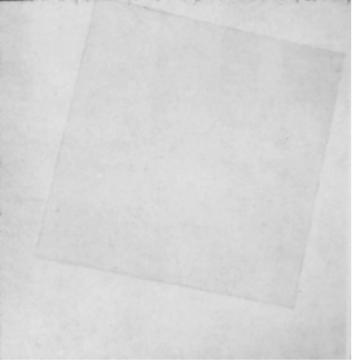
The white portable set (below. figure 1) was like modernist geometric painting including extreme color reduction. It called to mind Kazimir Malevich’s 1918 painting, White on White (figure 2), and his contemporary’s, Piet Mondrian, paintings and spatial forms (figure 3). The play’s set was modularly built into columns with 4x4 footprints and heights ranging from 10 to 16 feet. Though not visible, their base included wheels, allowing for quick almost Tetris-like repositioning. Each column included a door-sized passage, but like the wheels, they were kept out of audience view. The interiors were lined with white non-reflective fabric so if per chance the passage were slightly exposed to the audience, it would go unnoticed. These passages functioned to hide stagehands that would mid-scene provide characters with prop and mics.

figure 1: set detail

figure 2: Malevich, White on White

figure 3: Mondrian

The neutral white and geometric simplicity diminished scenic distractions so that the plays action was perceptually foregrounded. It also reduced the need and risks in replication or accuracy of the temporal and geographical setting. In fact, it decontextualized the play from the early seventeen hundreds scripted setting. The only ground to situate the viewer in the temporal location was the design of the costumes and key props.

In the decontextualized space, the repositioning of the columns indicated scene changes. With each shift, various flat panels, reminiscent of the columns’ Mondrian-like surfaces, were lowered from the ceiling to further reshape the space, as a sign to cue scenic change. The transitions were made in full audience view. Despite the physical repositioning, it was each scene’s action that dictated how the space should be interpreted—pub or pasture, day or night, plus indicating Mother Courage’s migratory habit. I found the set and its repositioning aesthetically soothing. It counterbalanced the emotive connotations associated with theatrically required projections of voice and gesture.

The play would have been significantly served by decontextualizing it beyond just the white set to release its primary read from being tethered to seventeen hundreds. Converting all the costuming and props to white with the exception of each characters vest, sash or a single item of distinction, while maintaining their antiquated design, would have effectively diminished the chronological anchor. This would have emphasized the characters’ actions and script in ways that would transcend the time period becoming more applicable for today. It would correlate the plot in terms of our own cultural and global climate with its dragged out “incursions,” leftovers of our War on Terror, and other political interventions. Only in unpacking the play for this paper has the probable intention of the director’s selection of Mother Courage revealed real correlations.

Raytheon, a weapons guidance system corp, is a most profitable stock. I shall neither confirm nor deny that I may own some. Perhaps it has even assisted in temporarily freeing me to pursue my PhD. Am I equally complicit and compromised by the benefits of war, as Mother Courage was? Do I stand on carcasses of others as I reach for yet another degree? Had the play more clearly de-tethered from its historical fix, I would have arrived at the uncomfortable position that reveals me as part of our contemporary war economy. This would have been quite poignant because it would turn my harsh judgment of Mother Courage around on myself. I like to be unsettled, moved from my willful blindness and American arrogance. I wish the play itself had done this for me, it did not. I maintain my buffered ego and denial. Plus perhaps  I also bought Tesla stock when it first hit the market. Ha. Apparently, I am into clean energy and bombing, just call me Mother Courage.

It would be perfect to end this post at the last line, but then I would have to re-title it. I ramble on with the review for class criteria hoop jumping and to get to the Oompa Loompas, the play’s best part ☺. But first a little more on the set. The drop down paintings as contextual staging were problematic. The only painting that assisted the play in terms of progressing the story was the replica of Goya’s painting, May Third. The first and last paintings where exceptionally disruptive—perceptually fixating. The first glowed neon orange—visually eye riveting, screaming. The last was a gargantuas muddy brown blob OZ head. Its scale made it impossible to ignore. I assume, though unrecognizable to me, it referenced a historical painting, but it was just shit ugly and distracted me from the story.

On the other hand, I loved the clothes racks packed with cadaverous heads and their disemboweled torsos with dangling entrails. Then again, perhaps I own Raytheon stock. Sigh. In a manner, the cadavers correlated with the staging in that they decontextualized the play from the “real” and its temporal location in history. The clothing store-like racks linked the story to contemporary culture, perhaps pointing to the costs of our consumer-based economy. I appreciated the way the abstraction and repetition suggested the horrors and carnage of war with the multiple racks signaling ongoing death counts.

The acting and singing left me wanting. As fine an actress as Mother Courage was, she was not even remotely my favorite character. The very best thing about the play was the Oompa Loompas, apparently recast from Willie Wonka and the Chocolate Factory. Though neither short nor bearded, they dressed hygienically, donned in all white paper industrial-like coveralls, including white foot booties that muffled the sound of their walking. They functioned between scenes, just as they did in the movie when cued by Wonka and set to the task of scene transition by rolling off the Blueberry Girl for squishing or the other "bad" children for obvious consequences.


Likewise, in Mother Courage, a buzzer, followed by a holler, “scene change,” activated the scenic inbetweens. The Oompas moved silently with calculated intent as they danced the white columns to new positions. It was just freaking beautiful. The music played softly in accompaniment, but I was so fixate on their coordination and efficient movements it really didn’t register. I would have been happy with three hours of that or at least twenty-two minutes. In either case, I would need a hint of a conceptual intent. Seriously, I might have preferred the play’s narrative without bodily action. With the characters garbed in white costume, proplessly standing behind a series of white podiums, lined up in a row, voicing their lines. And then holding still and silent as the Oompa Loompas, initiated with the buzzer and pre-emptive holler, “scene change,” did their thing. Even with unaltered script, this would have teleported the viewer from the past to the future of now. Oh, I would have been so engaged. Sometimes “less is more” though that would require a butt-load of risk and courage.

Ha, and would the Oompa Loompas songs be relevant to Brecht’s script? I think so. It is worth a test, in creating a new version of Mother Courage worth doing.


NOTE: Perhaps interdisciplinary in development, Mother Courage seemed to fit my stereotype of conventional three parts play and one part musical.

Sunday, March 08, 2015

I love my hands and want to keep functional every freaking finger and my opposables for these are my assets that render me recognizably human, well at least semi-hairless primate.

I love my hands and want to keep functional every freaking finger and my opposables for these are my assets that render me recognizably human, well at least semi-hairless primate. And, though I also love the scholarly thing, I miss using my hands gnarly and exhaustively each day.


THE SHORT VERSION of a smidgen of the remembered

I sat in a waiting room, not one I had been in before. With my head slightly tilted I watched the man five seats down on my left. He was clean cut, dark haired, casual but well dressed, perhaps twenty-five. He flipped through the slick pages of a magazine. Something seemed not quite right. I was fixed on his hands when it dawned on me that his fingers were toes.
The uniform loss of digits on both hands seemed suggestive of machine precision, an industrial accident. The expletive fingers still absent, the others had been adapted from his big toes and its second. The pointer toe digit and his opposable toes, now thumbs, flipped pages. No redness, residual mangling or scar. The fat pads of the toes had diminished with their changed use. Perhaps he now balances with upon his feet with little toe prosthetics. 


The teenage boy seated next to me interrupted my stare as he leaned nearer to me. I turned noting the professionally bandages wrapped on each wrist. Nodding down with an ask, almost boastful he exclaimed how he hadn't cut deep enough when he tried to kill himself, but instead had severed and damaged both nerves and tendons. It was a unexpected disclosure. His mother sat with her head down, jaw and body tight. A bodily gesture I recognized as agonized anger and shame. I neither wanted to reward the boy's boastful call for attention nor judge him harshly with my bodily attentions. So, I attempted gentle eye contact and nods as he talked and I listened.


The door opposite the check-in sliding window, the exit from which I had entered, opened. A woman was rolled in a wheelchair, she was situated and parked. The roller bent and said something quietly in her ear and then departed. Each of her arms, parallel and fully extended forward, were splinted and freshly bandaged. Both of her legs where like wise encased and extended. All four limbs shot out straight forward as if frozen in the act of warding off the impact of an oncoming car. Her entry left the room very silent as the toe-fingered man, the wrist-sliced teen, the angry mom and myself tried not to full on stare. 


The door, adjacent to the window, cracked opened, my name was called. I was lead to room five, the door shut as I waited to meet with my hand neurosurgeon. I’d with met him once before during my six hour ER visit, not in a waiting room but behind curtain number three, where I chattered scatologically, nervously,  incessantly for my full stay. It was my form of deflection while my finger was prepped with a digital block (a freaking long needle stuck in my fingers crouch between two and three) and the surgeon scrubbed its INSIDE. OMG, having the inside of your own body scrubbed is a thousand kinds of wrong, no matter that you can't feel it. Finally I was carefully stitched up, wrinkle by wrinkle aligned. All the while, two chain saw accident workers, who'd bounced the rotating teeth off their shins, apparently a common accident, waited. And I listened as the one covered gurney was extricated with each curtain being shut sequentially and its sound announcing the dead body's passing.


Sure, I had twenty-two stitches zipping up my recessive index finger, not toe, to pull things back together from the inadvertent butterfly fillet resulting from wrestling with my black gator,* but I was pretty sure my finger would be fine. I hadn't cross cut my tendons and nerves, just sliced up the middle of them from my nailed tip to knuckle, exposing the bone. Sigh, though if you pinch the back of your finger, you'll see this did not involve a lot of hurt, just OMG, I see my bones. 

I had never consciously considered before that I should probably seriously protect my hands and fingers, for they are dear assets. That my eight digits, two opposables, and language make me uniquely operationally as human had previously gone unthunk (yes). It was only sitting in the  waiting room witnessing a single day in the office of a hand neurosurgeon that these thoughts surfaced to my consciousness.


And I wasn't even sculptress yet! But, it was my pre-lesson in noncommercial tool safety before I owned a table saw, bandsaw, miter saw, chop saw, jigsaw, circular saw. 


I love my hands and want to keep functional every freaking finger and my opposables for these are my assets that render me recognizably human, well at least semi-hairless primate.


* gator = gatorboard = a type of foamcore with a thin sheath of bulsa wood in it; my blade = exacto knife; and the bite = slippage while running its blade along a metal ruler's edge and inadvertently up my index finger.  Slicing the back of your finger actually doesn't hurt (go ahead pinch the back of your finger...nada). Only three things hurt: 1. when they vigorously scrubbed INSIDE my finger (WTHeck..seriously no one should scrub under your skin!!!), the digital block (the needle they stick between your fingers and then twist around injecting the deadening) and OT sessions.


Photograph by Katy Anderson


Tuesday, March 03, 2015

[performative utterance] + [prostituted prop] + [performative principles] = art as research [SITE}


A long time ago I got in the habit, never since broken, of writing down things instead of talking. It is possible that I was lead into art making because talking and being in the presence of another person were not requirements. — Robert Morris, 2013 [Lecture @ University of Chicago] 
Robert Morris’ artistic praxis finds ground in art as research. In this vein, his substantial body of work exhibits a thoughtful exploration of the art object as performative, the viewer’s position as interventional, and the thought theme, agency, called into question. It seems a logical intent to unpack how these explorations of the performative, intervention, and agency via his use of substitution, imitation and exchange are evident in his performance, Site (1964). Additionally, his praxis and resultant works fluidly cross genre boundaries between sculpture, performance, dance, text, criticism, and art history in a way that disrupts the regulatory fiction of disciplinary coherence.

I am not yet ready to throw down the gauntlet of a definitive argument, but the above paragraph is the direction I am heading. Though if I must throw down a specific gauntlet, it will be that Robert Morris’ artistic praxis and resultant works fluidly cross genre boundaries between sculpture, performance, dance, text, criticism, and art history in a way that disrupts the regulatory fiction of disciplinary coherence. Of course, I totally stole this and repurposed it from Judith Butler’s constitutive notion of gender coherence. I have simply overlaid it relative to disciplinary coherence. Perhaps this makes Robert Morris’ praxis less inter-disciplinary and more transGENRE*. Ha. I will have to reread Butler [Performative Acts and Gender Constitution: An Essay in Phenomenology and Feminist Theory] to see if it is a fit. Could be an interesting part of the argument, since Greenbergian Modernism is so freaking patriarchal, isolates the genre’s as uniquely discrete, and Morris pushed up against this in his praxis and essays.
A sane mind should not be guilty of a logical fallacy. — Henri Poincare, 1902
The abolition of logic, the dance of the impotents of creation! — Dada Manifesto, 1918
Illogical judgments lead to new experience. — Sol LeWitt, 1969
*Abstract Appendix TRANSGENRE [stolen from Wikipedia and shoved through the notions of Judith Butler | italics denote my word substitutions]

  1.  Of, relating to, or designating a practice whose identity does not conform unambiguously to conventional notions of genre disciplinarity, but combines or moves between these.
  2. Practices who were assigned a disciplinary genre, usually at birth and based on their physiological neural activation, but who feel that this is a false or incomplete description of themselves.
  3. Non-identification with, or non-presentation as, the genre (and assumed genre) one was assigned at birth.
  4. A transgenre practices may have characteristics that are normally associated with a particular discipline and identify elsewhere on the traditional genre continuum, or exist outside of it as other, agenregenre neutral, genre ueer, non-binary, third genre  etc. Transgenre practices may also identify as bigenre, pangenre, or along several places on either the traditional transgenre continuum or the more encompassing continuums that have been developed in response to recent, significantly more detailed studies. Furthermore, many transgenre practices experience a period of identity development that includes better understanding one’s self-image, self-reflection, and self-expression. More specifically, the degree to which individuals feel genuine, authentic, and comfortable within their external appearance and accept their genuine identity is referred to as transgenre congruence. 
[http://en.wikipedia.org/wiki/Transgender]

Footnotes later...assume ideas are being borrowed and mashed together.

Sunday, March 01, 2015

Judith Butler and transGENRE (ha)

Just playing with labels and understanding the fluidity of the less than fixed disciplines within the academy.

I don’t care for the term interdisciplinary. It is too loose, too overused and misused. It also infers a dividedness. An interdisciplinary artist would appear to dip her toe in discrete finite disciplinary pools; but this seems not quit accurate. Artists, the list to numerous to list, that are prolific in production, persistent in practice through life, and are known not just locally but more globally, tend to have a transgenre practice (even if what is publicly presented is mongenred). Like life and practice, the lines become blurry in their fictions.

At first with the unpacking of Butler’s notions of the constitutive nature of gender, I transferred it the nature of interdisciplarity as a kind of transgenre practice. So I move from Butler’s transgendered people to transGENRE practices.

TRANSGENRE [stolen and morphed from Wikipedia http://en.wikipedia.org/wiki/Transgender]

  1. Of, relating to, or designating a practice whose identity does not conform unambiguously to conventional notions of genre or disciplinary roles, but combines or moves between these.

  2. Practices who were assigned a disciplinary genre, usually at birth and based on their physiological neural activation, but who feel that this is a false or incomplete description of themselves.

  3. Non-identification with, or non-presentation as, the genre (and assumed genre) one was assigned at birth.

  4. A transgenre practices may have characteristics that are normally associated with a particular discipline and identify elsewhere on the traditional genre continuum, or exist outside of it as other, agenre, genre-neutral, genrequeer, non-binary, third genre, etc. Transgenre practices may also identify as bigenre, pangenre, or along several places on either the traditional transgenre continuum or the more encompassing continuums that have been developed in response to recent, significantly more detailed studies. Furthermore, many transgenre practices experience a period of identity development that includes better understanding one’s self-image, self-reflection, and self-expression. More specifically, the degree to which individuals feel genuine, authentic, and comfortable within their external appearance and accept their genuine identity is referred to as transgenre congruence
    [http://en.wikipedia.org/wiki/Transgender]

——————

Of course once I finished this play, I went to google only to discover the usual, transgenre is not a new notion. Of course I knew this would be so for even Plato (and Bart Simpson) thunk (!) all my thoughts before me.

I found Alexander Refsum Jensenius unpacking of the differences within disciplinary labels and providing a nice little visual
interdisciplinary —>  multidisciplinary —> Cross disciplinary —>  interdisciplinary —> transdisciplinary 

Thursday, February 19, 2015

There is a forgetfulness between self and context...The foot twitches; the mind thinks. The mind thinks; the foot twitches. The mind twitches; the foot thinks. The foot thinks; the mind twitches. Perhaps.

An unfootnoted musing for a toe dipping short term project

Option A—the easy way: Analysis of interdisciplinary product (outcome)—Robert Morris and Carolee Schneeman

Option B—the less easy*: Analysis of Intermodal process (income)—Contemporary intermodal artistic practice of writing and ___ The unnoticed role of writing as a collaborator in non-literary artistic production

It is my hypothesis that successful artists (prolific, persistent [life long practice], and known) have an intermodal (interdisciplinary) practice that involves their known mode of production and the mode of writing (often unnoticed). Not with emphasis on individual or even team, but in terms of broader population patterns, I would like to consider the artistic mode of writing in terms of what functions it may play in sustaining and/or substantiating an artist’s primary practice. Specifically for this project I would like to consider how psychological findings on rates of healing, mental and physical health, and vocational success might inform or support an intermodal practice of writing and ___ for the artist. Secondarily, I would like to begin looking at theories of situated (embodied) cognition that might equally shed light on the function of writing. I believe these are some how linked in why an intermodal (interdisciplinary?) artistic practice incorporating writing and another primary artistic mode may assist the artist in being prolific, persistent, and known. What are the relevant implications for the artist?

If I need to wrap it around specific artists, how about ? Agnes Denes, Yvonne Rainer, and Twyla Tharp—all have available writing samples worth review in light of the psychological research on writing.

Background thinking inside my head

The foot twitches; the mind thinks. The mind thinks; the foot twitches.
The mind twitches; the foot thinks. The foot thinks; the mind twitches.
Perhaps.

Martin Heidegger suggests, “There is a forgetfulness between self and context.”

If the non-literary artist’s practice is situated, grounded and worked out primarily in the encounter and engagement of material and social context, if art making/art product is dependent on the primacy of embodied experience, does the act of writing somehow bridge the gap between the social and material encounter with the portion of consciousness that is language bound [commonly called the self]? Current radical trends in neuro-cognition suggest language based conception is like a residual aftermath of situated (embodied) conception, cognition. Does effective artistic production require an intermodal practice, a more substantial play between encounter/body and mind? Does the sustainment, development and success in an explicit artistic mode require sub or parallel mode in writing?

I am not suggesting that this intermodal practice is in evidence or needed for all artists, perhaps it is personality or personal process dependent. I just know there is an overwhelming amount of “famous” visual artists in the last 100 years that write.

*less easy simply means there is no well trodden trail for me to follow.

Tuesday, January 27, 2015

abstraction and ambiguity -- two magnets, one mom and a refrigeratordoor -- take three

If you follow me much, than you know I hide behind ambiguity and abstraction. This is true for my work that inhabits both real (art) and cyber space (blogged writings)--by god I stitch with tie wire self referential forms from dilapidated combine tubes. I hide in plain sight. I stand stripping naked yet rarely exposed...well, unless you've read my entire freaking blog and intuitively fill in the emptied nail holes (read between the lines) I've left behind. Those of you that push the putty, fill the holes, hear the humor in my own piddley passage. I think eventually you find some ground from which to see me. Pretty sure you do.

Buttttt. As always I have a big (somewhat skinny) but. And that but is that I'd like to be hintfully more clear. So I sit in a creative nonfiction graduate workshop grappling with my big but. I bite my lip in retort, post oral class reading. It seems so blatantly clear to me...alas...this is definitely not the first time I've run into my own big butted ambiguity and abstraction...

Sigh.
Yup, in elementary school I was always circularly corralled in the dumb oral reading groups. Gosh, even I knew the why for the way words twisted off my lips [then as now], my cheeks burned cherry red, and all cognitive conceptions canceled. Even the former, two and a half decade long, legal love unit was perpetually shocked and mildly mocked my blatantly blabbed butchery. I remember multiple sullen Saturday morns when he trudged next to me trying to break a part "especially." It simply would  do nothing but mutate in its roll from my tongue. And he'd repeat -- Eeeee. Spesh. Aaa. LEE. Eeeee. Spesh. Aaa. LEE. No, really Kathy! I was thirty three. Sigh. Eeeee. Spesh. Aaa. LEE. Especially. Finally now, today, unmalformed it flows as the unit strolls by in my head as I go  Eeeee. Spesh. Aaa. LEE. Ha. 
Oh yes, I did flunk sophomore "Five-Hundred Word Theme" with a forty-seven, repeated again for a C. Dormed and degree bound, first one, I was stuck in remedial writing--same freaking textbook I survived with an F then a C. OMG. I deferred my remainder, English courses that is, to the end, hoping I might be raptured before then. Dang my unrapturedness.  
A decade later, hired as director of communication, I explained that I might edit BUT would not write. I would not write. I was clear. Of course, I also told them I would not wear a dress either. I’ve quite a few big buts. 
So I find it infinitely humorous on degree three, that at least three art historians, really, one, two, three--Brauer, Padget, and Jacobs--suggested I had a knack to write and criticize. Head that direction. Ha, the blatantly blabbed butchery bound to each page was simply ignored, for the compression of critical content couched in hidden humors they got. A, A, A, A, A, A, A, A and another. I contemplated degree four in writing and critical theory.  Five seconds then done. I was tribe bound with a legal love unit, so that was to be ignored. Hugh. Huh. Hmmm. Welp, here I am. 
Now sans one legal love unit, I write with little shame. But, but, BUT could I just be a tad more freaking textually clear?!

That said, here is rewrite three in which I try to ground my ungrounded graduate reader, post my oral presentation. Next week I’ll do a re-right again, trying to work further around my big ambiguous but that blocks my way.

--- Draft three ---

Two magnets, one mom and a refrigerator door
Your eyes shift down from their low casting across the long table’s surface to the one with blush burned cheeks. With eyes averting, you wait for something small, something smart, worth the wasted while. Waiting. Waiting. My cheeks burn all the more in the stalled stretching span. The words on the page coarsely twist off my lips. Stupidity overwhelms me in that first unrecoverable instance.

My nose flares with a frustrated hmmph. In fact, there are no words on the page to twist off my lips, and you, you, and you, with your already penned publishes, gathered here in round three of each of your piling up English degrees, have yet to sit.

Hunched over my desk, I look to my right. I hesitate, hating that damn black bulldog clip thingy. It sits silently clasping itself, clinging impotently and unused to my wall mounted magnetic strip. Waiting, I calculate and cull from Paper Clips, Sausage, Candy Cigarettes, Silk: ‘Thingy-ness’ in Flash Nonfiction—but the black bulldog clip’s thingy-ness remains verbless and voiceless. There is no fusion of form or frame for content or cognition. No muse at all, just a damn mute thingy. It watches me subjectlessly grope my way through the assigned text. I turn the page hoping for more from the next. I stop. I wait. I try not to do smart. Smart is stupid. It stalls me, binding up as yet unwritten moments. I stare empty eyed at that stupidly smart bulldog clip, clamped shut, failing to give voice. I hold there, for a memory of my own, for histories released. I wait; I waffle, like an unmoored blank page a drift to the floor.

And, I mull down on my unwritten, unadmitted, why. That why that planted my ass right here for yet another but final degree. It sits heavy, I try to leverage it to push the pen. Nothing. Instead, I cultivate convincing myself to just freaking mimic the process I forced, a mere forty-eight hours ago, on my drawing students, set with the remedial task of blind contours. Literally positioning each with a laterally outstretched penciled arm, reaching slightly behind them to mark their easeled, bulldog clamped pad. They stare into a stool perched peer’s face, a mere socially inappropriate two feet in front of them, stretching the non-penciled arm forward, finger extended, pointedly poking and tracing the multiple contours of a face not their own. Leaving a mere lead trace, the pencil and padded hand translates with one continuous threading line. So focused, they work until their shoulders’ scream with exerted burn. Arms windmill around the room and then each set returns to their page. The drawings develop; find face in a process not a product. It’s a way of unlearning their cognitively compressed perceptual knowings. One eye large, one small and displaced below the nose, the ear a cheek, the chin so small, the nose laps over the mouth. Each distortedly different—fragility and frustration processed, released. Those that forego fixation on the final outcome, find face. The drawings oddly read as real. On the other hand, those penciled from the cognitively coerced are worth only two magnets, one mom, and a refrigerator door.

My mind returns me to put pen to page in a parallel process, to write. Of course, this is a lie. I thumb my digital device, swiping away my glossed knowings, my false facades and my repetitive reviews of the LIKES on my most recent Facebook update. Hmmmph. I point to the damn convoluting contours of that impotent clip and my mind's eye fingeringly follows my own blind unfaked fragility and frustration with this forced first draft. I feel the residual taint of my own feared stupidity and am left with missing my mom, two magnets and her refrigerator door.

--------------------------------------- 
Funny after drafting this up I find myself reading Alexander Smith, circa 1892, On Writing Essays. Ha, while speaking of the essayist Montaigne, he notes, 
"The essayist plays with his subject, now whimsical, now in grave, now in melancholy mood. He lies upon the idle grassy bank ... letting the world flow past him, and from this thing and the other he extracts his mirth and his moralities... as I walk through the woods... His habit of mind is leisurely; he does not write from any special stress of passionate impulse; he does not create material so much as he comments upon material already existing ... His main gift is an eye to discover the suggestiveness of common things... If you wish to preserve your secret, wrap it up in frankness... He laughs at himself and his reader ... you suspect mockery or banter in his tones. He is serious with the most trifling subjects, and he trifles with the most serious." 
Of course I live in 2015, am female, and at the moment, less than idle. But I miss the idle and speaking to the common place of the moment. I miss laughing at myself and being my own egotistical primary source. 
--------------------------------------- 

Two magnets, one mom, and a refrigerator door


Your eyes shift down from their low casting across the long table’s surface to the one with blush burned cheeks. With eyes averting, you wait for something small, something smart, worth the wasted while. Waiting. Waiting. My cheeks burn all the more in the stalled stretching span. The words on the page coarsely twist off my lips. Stupidity overwhelms me in that first unrecoverable instance.

My nose flares with a frustrated humph. In fact, there are no words on the page to twist off my lips, and you, you have yet to sit. I look to my right.

I hesitate, hating that damn black bulldog clip thingy. It sits silently clasping itself, clinging impotently and unused to my wall mounted magnetic strip. Waiting. Its thingy-ness remains verbless and voiceless. There is no fusion of form or frame for content or cognition. No muse at all, just a damn mute thingy. It watches me subjectlessly grope. I stop. I wait. I try not to do smart. Smart is stupid. It stalls me, binding up as yet unwritten moments. I stare empty eyed at that stupidly smart bulldog clip, clamped shut, failing to give voice. I hold there, for a memory of my own, for histories released. I wait; I waffle, like an unmoored blank page a drift to the floor.

And, I mull down on my unwritten party line as to why I am here. It sits heavy, I try to leverage it to push the pen. Nothing. Instead, I cultivate convincing myself to just freaking mimic the process I forced a mere forty-eight hours ago on my drawing students, set with the remedial task of blind contours. Literally positioning each with laterally outstretched penciled arms, reaching slightly behind them to mark their easeled, bulldog clamped pad. They stare into a stool perched peer’s face, a mere socially inappropriate two feet in front of them, stretching the non-penciled arm forward, finger extended, pointedly poking and tracing the multiple contours of a face not their own. Leaving a mere lead trace, the pencil and padded hand translates with one continuous threading line. So focused, they work until their shoulders’ scream with exerted burn. Arms windmill and then return to the page. The drawings develop; find face in a process not a product. It’s a way of unlearning cognitively compressed perceptual knowings. One eye large, one small and displaced below the nose, the ear a cheek, the chin so small, the nose laps over the mouth. Each distortedly different—fragility and frustration released. Those that forego fixation on final outcome, find face. The drawings oddly read as real. On the other hand, those penciled visually and cognitively coerced are worth only two magnets, one mom, and a refrigerator door.

So I put pen to page in a parallel process, but to write. Of course, this is a lie. I thumb my digital device, swiping away my glossed knowings, my stupidly false facades and my repetitive reviews of the LIKES on my most recent update. Hmmmph. I point to the damn convoluting contours of that impotent clip and my mind's eye fingeringly follows my own blind continuity of unfaked fragility and frustration with this forced first draft.

I am left with missing my mom.

Thursday, November 06, 2014

subjugate that!
first scholarly neophyte research question to pursue relative to my dissertation interests

RESEARCH QUESTION:
Are contemporary female visual artists using self subjugating language?

—-end of requested—-

Language sampling source and narrowing the playing field:
Kristine Stiles and Peter Selz’s text, Theories and Documents of Contemporary Art: A Sourcebook of Artists’ Writings, 2nd Ed, published in 2012, in addition to male artist writings and interviews, the text contains seventy-seven writings by female artists and twenty-four interview transcripts with female artists. The female samples will be used as source material for analysis relative to the research question.

Sampling source narrows female category to

  1. visual artists practicing within the last 100 years 
  2. artists established as relevant to the art world by art historians via inclusion of artists’ writings and interview transcripts in published anthologies 
  3. artists who vary in conceptual and physical practices 
  4. to a manageable quantity 

Based on this source material, a logical follow up presents itself as: Are the patterns relative to self-perceived position expressed differently in a female visual artists’ writings versus her use of language in an interview?

The research and methodologies will draw from the field of psychology/linguistics and a literature review searching for pre-existing material, methods, or lines of questioning in the fields of art theory and/or art criticism that might be relevant or theoretically transferable into the study of the language use of visual artists.