Saturday, April 18, 2015

three different presentation/papers three sequential days. brow wipe. sigh

two of the three went well. the third i got bogged down, distracted a stymied on the conference's old laptop, finding the buttons and touch pad clumsy. sigh. next time i just break the rules and plug in my mac. then i can not only run my presentation from my phone and stand anywhere, but can also see my notes simultaneously! my presentations are typically dependent on visuals, they actually provide unsaid information, now they also include key stats, which in my mine, numbers are better seen than said.

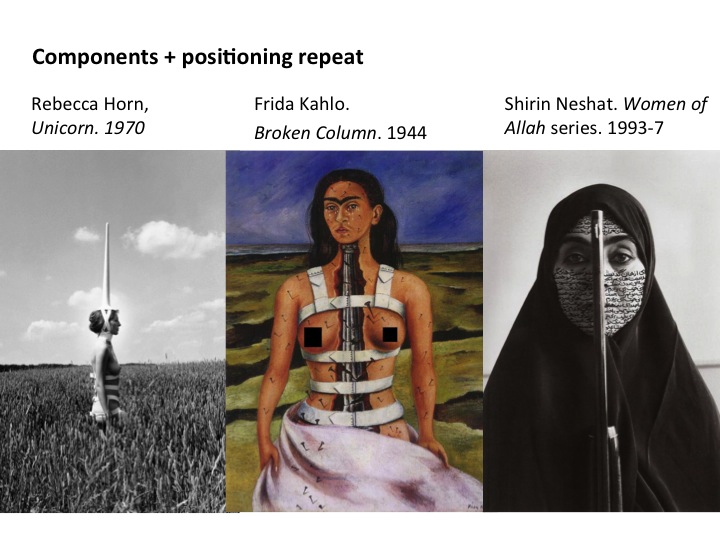
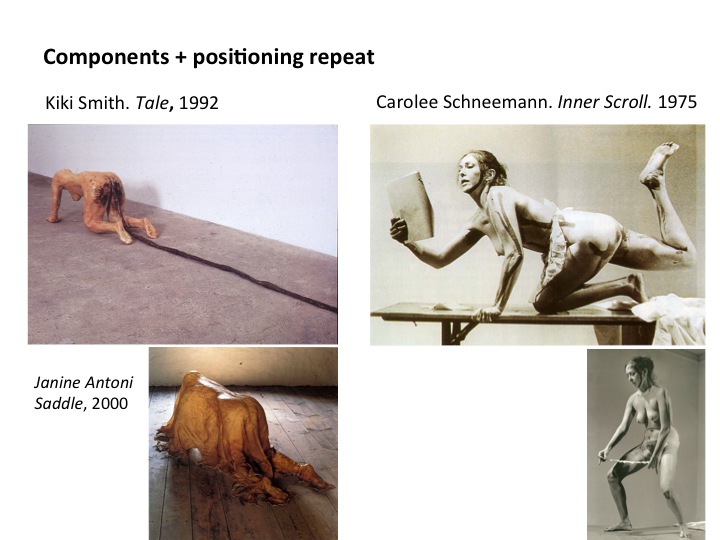
here is partial sampling of my three on three. remember you are not getting the verbal commentary, just a half snippet. PS I love Janine Antoni, Robert Morris, and Schneeman's work. How could they not be freaking influential on my primary practice. PSS I am not a historian, but a practicing studio artist, plus grad student, and I teach/present from this perspective.

in the written text of female visual artists are there linguistic traces of self-limiting social positioning?


Robert Morris | agile evasion of disciplinary definition = transgenred


the body is never neutral, never silent [contemporary art history]


 ps. disclaimer - imagery was used for educational purpose in educational setting. outside of a grade, honoring, and self-respect, there was no fiscal benefit.


Sunday, March 08, 2015

I love my hands and want to keep functional every freaking finger and my opposables for these are my assets that render me recognizably human, well at least semi-hairless primate.

I love my hands and want to keep functional every freaking finger and my opposables for these are my assets that render me recognizably human, well at least semi-hairless primate. And, though I also love the scholarly thing, I miss using my hands gnarly and exhaustively each day.


THE SHORT VERSION of a smidgen of the remembered

I sat in a waiting room, not one I had been in before. With my head slightly tilted I watched the man five seats down on my left. He was clean cut, dark haired, casual but well dressed, perhaps twenty-five. He flipped through the slick pages of a magazine. Something seemed not quite right. I was fixed on his hands when it dawned on me that his fingers were toes.
The uniform loss of digits on both hands seemed suggestive of machine precision, an industrial accident. The expletive fingers still absent, the others had been adapted from his big toes and its second. The pointer toe digit and his opposable toes, now thumbs, flipped pages. No redness, residual mangling or scar. The fat pads of the toes had diminished with their changed use. Perhaps he now balances with upon his feet with little toe prosthetics. 


The teenage boy seated next to me interrupted my stare as he leaned nearer to me. I turned noting the professionally bandages wrapped on each wrist. Nodding down with an ask, almost boastful he exclaimed how he hadn't cut deep enough when he tried to kill himself, but instead had severed and damaged both nerves and tendons. It was a unexpected disclosure. His mother sat with her head down, jaw and body tight. A bodily gesture I recognized as agonized anger and shame. I neither wanted to reward the boy's boastful call for attention nor judge him harshly with my bodily attentions. So, I attempted gentle eye contact and nods as he talked and I listened.


The door opposite the check-in sliding window, the exit from which I had entered, opened. A woman was rolled in a wheelchair, she was situated and parked. The roller bent and said something quietly in her ear and then departed. Each of her arms, parallel and fully extended forward, were splinted and freshly bandaged. Both of her legs where like wise encased and extended. All four limbs shot out straight forward as if frozen in the act of warding off the impact of an oncoming car. Her entry left the room very silent as the toe-fingered man, the wrist-sliced teen, the angry mom and myself tried not to full on stare. 


The door, adjacent to the window, cracked opened, my name was called. I was lead to room five, the door shut as I waited to meet with my hand neurosurgeon. I’d with met him once before during my six hour ER visit, not in a waiting room but behind curtain number three, where I chattered scatologically, nervously,  incessantly for my full stay. It was my form of deflection while my finger was prepped with a digital block (a freaking long needle stuck in my fingers crouch between two and three) and the surgeon scrubbed its INSIDE. OMG, having the inside of your own body scrubbed is a thousand kinds of wrong, no matter that you can't feel it. Finally I was carefully stitched up, wrinkle by wrinkle aligned. All the while, two chain saw accident workers, who'd bounced the rotating teeth off their shins, apparently a common accident, waited. And I listened as the one covered gurney was extricated with each curtain being shut sequentially and its sound announcing the dead body's passing.


Sure, I had twenty-two stitches zipping up my recessive index finger, not toe, to pull things back together from the inadvertent butterfly fillet resulting from wrestling with my black gator,* but I was pretty sure my finger would be fine. I hadn't cross cut my tendons and nerves, just sliced up the middle of them from my nailed tip to knuckle, exposing the bone. Sigh, though if you pinch the back of your finger, you'll see this did not involve a lot of hurt, just OMG, I see my bones. 

I had never consciously considered before that I should probably seriously protect my hands and fingers, for they are dear assets. That my eight digits, two opposables, and language make me uniquely operationally as human had previously gone unthunk (yes). It was only sitting in the  waiting room witnessing a single day in the office of a hand neurosurgeon that these thoughts surfaced to my consciousness.


And I wasn't even sculptress yet! But, it was my pre-lesson in noncommercial tool safety before I owned a table saw, bandsaw, miter saw, chop saw, jigsaw, circular saw. 


I love my hands and want to keep functional every freaking finger and my opposables for these are my assets that render me recognizably human, well at least semi-hairless primate.


* gator = gatorboard = a type of foamcore with a thin sheath of bulsa wood in it; my blade = exacto knife; and the bite = slippage while running its blade along a metal ruler's edge and inadvertently up my index finger.  Slicing the back of your finger actually doesn't hurt (go ahead pinch the back of your finger...nada). Only three things hurt: 1. when they vigorously scrubbed INSIDE my finger (WTHeck..seriously no one should scrub under your skin!!!), the digital block (the needle they stick between your fingers and then twist around injecting the deadening) and OT sessions.


Photograph by Katy Anderson


Tuesday, March 03, 2015

[performative utterance] + [prostituted prop] + [performative principles] = art as research [SITE}


A long time ago I got in the habit, never since broken, of writing down things instead of talking. It is possible that I was lead into art making because talking and being in the presence of another person were not requirements. — Robert Morris, 2013 [Lecture @ University of Chicago] 
Robert Morris’ artistic praxis finds ground in art as research. In this vein, his substantial body of work exhibits a thoughtful exploration of the art object as performative, the viewer’s position as interventional, and the thought theme, agency, called into question. It seems a logical intent to unpack how these explorations of the performative, intervention, and agency via his use of substitution, imitation and exchange are evident in his performance, Site (1964). Additionally, his praxis and resultant works fluidly cross genre boundaries between sculpture, performance, dance, text, criticism, and art history in a way that disrupts the regulatory fiction of disciplinary coherence.

I am not yet ready to throw down the gauntlet of a definitive argument, but the above paragraph is the direction I am heading. Though if I must throw down a specific gauntlet, it will be that Robert Morris’ artistic praxis and resultant works fluidly cross genre boundaries between sculpture, performance, dance, text, criticism, and art history in a way that disrupts the regulatory fiction of disciplinary coherence. Of course, I totally stole this and repurposed it from Judith Butler’s constitutive notion of gender coherence. I have simply overlaid it relative to disciplinary coherence. Perhaps this makes Robert Morris’ praxis less inter-disciplinary and more transGENRE*. Ha. I will have to reread Butler [Performative Acts and Gender Constitution: An Essay in Phenomenology and Feminist Theory] to see if it is a fit. Could be an interesting part of the argument, since Greenbergian Modernism is so freaking patriarchal, isolates the genre’s as uniquely discrete, and Morris pushed up against this in his praxis and essays.
A sane mind should not be guilty of a logical fallacy. — Henri Poincare, 1902
The abolition of logic, the dance of the impotents of creation! — Dada Manifesto, 1918
Illogical judgments lead to new experience. — Sol LeWitt, 1969
*Abstract Appendix TRANSGENRE [stolen from Wikipedia and shoved through the notions of Judith Butler | italics denote my word substitutions]

  1.  Of, relating to, or designating a practice whose identity does not conform unambiguously to conventional notions of genre disciplinarity, but combines or moves between these.
  2. Practices who were assigned a disciplinary genre, usually at birth and based on their physiological neural activation, but who feel that this is a false or incomplete description of themselves.
  3. Non-identification with, or non-presentation as, the genre (and assumed genre) one was assigned at birth.
  4. A transgenre practices may have characteristics that are normally associated with a particular discipline and identify elsewhere on the traditional genre continuum, or exist outside of it as other, agenregenre neutral, genre ueer, non-binary, third genre  etc. Transgenre practices may also identify as bigenre, pangenre, or along several places on either the traditional transgenre continuum or the more encompassing continuums that have been developed in response to recent, significantly more detailed studies. Furthermore, many transgenre practices experience a period of identity development that includes better understanding one’s self-image, self-reflection, and self-expression. More specifically, the degree to which individuals feel genuine, authentic, and comfortable within their external appearance and accept their genuine identity is referred to as transgenre congruence. 
[http://en.wikipedia.org/wiki/Transgender]

Footnotes later...assume ideas are being borrowed and mashed together.

Sunday, March 01, 2015

Judith Butler and transGENRE (ha)

Just playing with labels and understanding the fluidity of the less than fixed disciplines within the academy.

I don’t care for the term interdisciplinary. It is too loose, too overused and misused. It also infers a dividedness. An interdisciplinary artist would appear to dip her toe in discrete finite disciplinary pools; but this seems not quit accurate. Artists, the list to numerous to list, that are prolific in production, persistent in practice through life, and are known not just locally but more globally, tend to have a transgenre practice (even if what is publicly presented is mongenred). Like life and practice, the lines become blurry in their fictions.

At first with the unpacking of Butler’s notions of the constitutive nature of gender, I transferred it the nature of interdisciplarity as a kind of transgenre practice. So I move from Butler’s transgendered people to transGENRE practices.

TRANSGENRE [stolen and morphed from Wikipedia http://en.wikipedia.org/wiki/Transgender]

  1. Of, relating to, or designating a practice whose identity does not conform unambiguously to conventional notions of genre or disciplinary roles, but combines or moves between these.

  2. Practices who were assigned a disciplinary genre, usually at birth and based on their physiological neural activation, but who feel that this is a false or incomplete description of themselves.

  3. Non-identification with, or non-presentation as, the genre (and assumed genre) one was assigned at birth.

  4. A transgenre practices may have characteristics that are normally associated with a particular discipline and identify elsewhere on the traditional genre continuum, or exist outside of it as other, agenre, genre-neutral, genrequeer, non-binary, third genre, etc. Transgenre practices may also identify as bigenre, pangenre, or along several places on either the traditional transgenre continuum or the more encompassing continuums that have been developed in response to recent, significantly more detailed studies. Furthermore, many transgenre practices experience a period of identity development that includes better understanding one’s self-image, self-reflection, and self-expression. More specifically, the degree to which individuals feel genuine, authentic, and comfortable within their external appearance and accept their genuine identity is referred to as transgenre congruence
    [http://en.wikipedia.org/wiki/Transgender]

——————

Of course once I finished this play, I went to google only to discover the usual, transgenre is not a new notion. Of course I knew this would be so for even Plato (and Bart Simpson) thunk (!) all my thoughts before me.

I found Alexander Refsum Jensenius unpacking of the differences within disciplinary labels and providing a nice little visual
interdisciplinary —>  multidisciplinary —> Cross disciplinary —>  interdisciplinary —> transdisciplinary 

Thursday, February 19, 2015

There is a forgetfulness between self and context...The foot twitches; the mind thinks. The mind thinks; the foot twitches. The mind twitches; the foot thinks. The foot thinks; the mind twitches. Perhaps.

An unfootnoted musing for a toe dipping short term project

Option A—the easy way: Analysis of interdisciplinary product (outcome)—Robert Morris and Carolee Schneeman

Option B—the less easy*: Analysis of Intermodal process (income)—Contemporary intermodal artistic practice of writing and ___ The unnoticed role of writing as a collaborator in non-literary artistic production

It is my hypothesis that successful artists (prolific, persistent [life long practice], and known) have an intermodal (interdisciplinary) practice that involves their known mode of production and the mode of writing (often unnoticed). Not with emphasis on individual or even team, but in terms of broader population patterns, I would like to consider the artistic mode of writing in terms of what functions it may play in sustaining and/or substantiating an artist’s primary practice. Specifically for this project I would like to consider how psychological findings on rates of healing, mental and physical health, and vocational success might inform or support an intermodal practice of writing and ___ for the artist. Secondarily, I would like to begin looking at theories of situated (embodied) cognition that might equally shed light on the function of writing. I believe these are some how linked in why an intermodal (interdisciplinary?) artistic practice incorporating writing and another primary artistic mode may assist the artist in being prolific, persistent, and known. What are the relevant implications for the artist?

If I need to wrap it around specific artists, how about ? Agnes Denes, Yvonne Rainer, and Twyla Tharp—all have available writing samples worth review in light of the psychological research on writing.

Background thinking inside my head

The foot twitches; the mind thinks. The mind thinks; the foot twitches.
The mind twitches; the foot thinks. The foot thinks; the mind twitches.
Perhaps.

Martin Heidegger suggests, “There is a forgetfulness between self and context.”

If the non-literary artist’s practice is situated, grounded and worked out primarily in the encounter and engagement of material and social context, if art making/art product is dependent on the primacy of embodied experience, does the act of writing somehow bridge the gap between the social and material encounter with the portion of consciousness that is language bound [commonly called the self]? Current radical trends in neuro-cognition suggest language based conception is like a residual aftermath of situated (embodied) conception, cognition. Does effective artistic production require an intermodal practice, a more substantial play between encounter/body and mind? Does the sustainment, development and success in an explicit artistic mode require sub or parallel mode in writing?

I am not suggesting that this intermodal practice is in evidence or needed for all artists, perhaps it is personality or personal process dependent. I just know there is an overwhelming amount of “famous” visual artists in the last 100 years that write.

*less easy simply means there is no well trodden trail for me to follow.

Tuesday, January 27, 2015

abstraction and ambiguity -- two magnets, one mom and a refrigeratordoor -- take three

If you follow me much, than you know I hide behind ambiguity and abstraction. This is true for my work that inhabits both real (art) and cyber space (blogged writings)--by god I stitch with tie wire self referential forms from dilapidated combine tubes. I hide in plain sight. I stand stripping naked yet rarely exposed...well, unless you've read my entire freaking blog and intuitively fill in the emptied nail holes (read between the lines) I've left behind. Those of you that push the putty, fill the holes, hear the humor in my own piddley passage. I think eventually you find some ground from which to see me. Pretty sure you do.

Buttttt. As always I have a big (somewhat skinny) but. And that but is that I'd like to be hintfully more clear. So I sit in a creative nonfiction graduate workshop grappling with my big but. I bite my lip in retort, post oral class reading. It seems so blatantly clear to me...alas...this is definitely not the first time I've run into my own big butted ambiguity and abstraction...

Sigh.
Yup, in elementary school I was always circularly corralled in the dumb oral reading groups. Gosh, even I knew the why for the way words twisted off my lips [then as now], my cheeks burned cherry red, and all cognitive conceptions canceled. Even the former, two and a half decade long, legal love unit was perpetually shocked and mildly mocked my blatantly blabbed butchery. I remember multiple sullen Saturday morns when he trudged next to me trying to break a part "especially." It simply would  do nothing but mutate in its roll from my tongue. And he'd repeat -- Eeeee. Spesh. Aaa. LEE. Eeeee. Spesh. Aaa. LEE. No, really Kathy! I was thirty three. Sigh. Eeeee. Spesh. Aaa. LEE. Especially. Finally now, today, unmalformed it flows as the unit strolls by in my head as I go  Eeeee. Spesh. Aaa. LEE. Ha. 
Oh yes, I did flunk sophomore "Five-Hundred Word Theme" with a forty-seven, repeated again for a C. Dormed and degree bound, first one, I was stuck in remedial writing--same freaking textbook I survived with an F then a C. OMG. I deferred my remainder, English courses that is, to the end, hoping I might be raptured before then. Dang my unrapturedness.  
A decade later, hired as director of communication, I explained that I might edit BUT would not write. I would not write. I was clear. Of course, I also told them I would not wear a dress either. I’ve quite a few big buts. 
So I find it infinitely humorous on degree three, that at least three art historians, really, one, two, three--Brauer, Padget, and Jacobs--suggested I had a knack to write and criticize. Head that direction. Ha, the blatantly blabbed butchery bound to each page was simply ignored, for the compression of critical content couched in hidden humors they got. A, A, A, A, A, A, A, A and another. I contemplated degree four in writing and critical theory.  Five seconds then done. I was tribe bound with a legal love unit, so that was to be ignored. Hugh. Huh. Hmmm. Welp, here I am. 
Now sans one legal love unit, I write with little shame. But, but, BUT could I just be a tad more freaking textually clear?!

That said, here is rewrite three in which I try to ground my ungrounded graduate reader, post my oral presentation. Next week I’ll do a re-right again, trying to work further around my big ambiguous but that blocks my way.

--- Draft three ---

Two magnets, one mom and a refrigerator door
Your eyes shift down from their low casting across the long table’s surface to the one with blush burned cheeks. With eyes averting, you wait for something small, something smart, worth the wasted while. Waiting. Waiting. My cheeks burn all the more in the stalled stretching span. The words on the page coarsely twist off my lips. Stupidity overwhelms me in that first unrecoverable instance.

My nose flares with a frustrated hmmph. In fact, there are no words on the page to twist off my lips, and you, you, and you, with your already penned publishes, gathered here in round three of each of your piling up English degrees, have yet to sit.

Hunched over my desk, I look to my right. I hesitate, hating that damn black bulldog clip thingy. It sits silently clasping itself, clinging impotently and unused to my wall mounted magnetic strip. Waiting, I calculate and cull from Paper Clips, Sausage, Candy Cigarettes, Silk: ‘Thingy-ness’ in Flash Nonfiction—but the black bulldog clip’s thingy-ness remains verbless and voiceless. There is no fusion of form or frame for content or cognition. No muse at all, just a damn mute thingy. It watches me subjectlessly grope my way through the assigned text. I turn the page hoping for more from the next. I stop. I wait. I try not to do smart. Smart is stupid. It stalls me, binding up as yet unwritten moments. I stare empty eyed at that stupidly smart bulldog clip, clamped shut, failing to give voice. I hold there, for a memory of my own, for histories released. I wait; I waffle, like an unmoored blank page a drift to the floor.

And, I mull down on my unwritten, unadmitted, why. That why that planted my ass right here for yet another but final degree. It sits heavy, I try to leverage it to push the pen. Nothing. Instead, I cultivate convincing myself to just freaking mimic the process I forced, a mere forty-eight hours ago, on my drawing students, set with the remedial task of blind contours. Literally positioning each with a laterally outstretched penciled arm, reaching slightly behind them to mark their easeled, bulldog clamped pad. They stare into a stool perched peer’s face, a mere socially inappropriate two feet in front of them, stretching the non-penciled arm forward, finger extended, pointedly poking and tracing the multiple contours of a face not their own. Leaving a mere lead trace, the pencil and padded hand translates with one continuous threading line. So focused, they work until their shoulders’ scream with exerted burn. Arms windmill around the room and then each set returns to their page. The drawings develop; find face in a process not a product. It’s a way of unlearning their cognitively compressed perceptual knowings. One eye large, one small and displaced below the nose, the ear a cheek, the chin so small, the nose laps over the mouth. Each distortedly different—fragility and frustration processed, released. Those that forego fixation on the final outcome, find face. The drawings oddly read as real. On the other hand, those penciled from the cognitively coerced are worth only two magnets, one mom, and a refrigerator door.

My mind returns me to put pen to page in a parallel process, to write. Of course, this is a lie. I thumb my digital device, swiping away my glossed knowings, my false facades and my repetitive reviews of the LIKES on my most recent Facebook update. Hmmmph. I point to the damn convoluting contours of that impotent clip and my mind's eye fingeringly follows my own blind unfaked fragility and frustration with this forced first draft. I feel the residual taint of my own feared stupidity and am left with missing my mom, two magnets and her refrigerator door.

--------------------------------------- 
Funny after drafting this up I find myself reading Alexander Smith, circa 1892, On Writing Essays. Ha, while speaking of the essayist Montaigne, he notes, 
"The essayist plays with his subject, now whimsical, now in grave, now in melancholy mood. He lies upon the idle grassy bank ... letting the world flow past him, and from this thing and the other he extracts his mirth and his moralities... as I walk through the woods... His habit of mind is leisurely; he does not write from any special stress of passionate impulse; he does not create material so much as he comments upon material already existing ... His main gift is an eye to discover the suggestiveness of common things... If you wish to preserve your secret, wrap it up in frankness... He laughs at himself and his reader ... you suspect mockery or banter in his tones. He is serious with the most trifling subjects, and he trifles with the most serious." 
Of course I live in 2015, am female, and at the moment, less than idle. But I miss the idle and speaking to the common place of the moment. I miss laughing at myself and being my own egotistical primary source. 
--------------------------------------- 

Two magnets, one mom, and a refrigerator door


Your eyes shift down from their low casting across the long table’s surface to the one with blush burned cheeks. With eyes averting, you wait for something small, something smart, worth the wasted while. Waiting. Waiting. My cheeks burn all the more in the stalled stretching span. The words on the page coarsely twist off my lips. Stupidity overwhelms me in that first unrecoverable instance.

My nose flares with a frustrated humph. In fact, there are no words on the page to twist off my lips, and you, you have yet to sit. I look to my right.

I hesitate, hating that damn black bulldog clip thingy. It sits silently clasping itself, clinging impotently and unused to my wall mounted magnetic strip. Waiting. Its thingy-ness remains verbless and voiceless. There is no fusion of form or frame for content or cognition. No muse at all, just a damn mute thingy. It watches me subjectlessly grope. I stop. I wait. I try not to do smart. Smart is stupid. It stalls me, binding up as yet unwritten moments. I stare empty eyed at that stupidly smart bulldog clip, clamped shut, failing to give voice. I hold there, for a memory of my own, for histories released. I wait; I waffle, like an unmoored blank page a drift to the floor.

And, I mull down on my unwritten party line as to why I am here. It sits heavy, I try to leverage it to push the pen. Nothing. Instead, I cultivate convincing myself to just freaking mimic the process I forced a mere forty-eight hours ago on my drawing students, set with the remedial task of blind contours. Literally positioning each with laterally outstretched penciled arms, reaching slightly behind them to mark their easeled, bulldog clamped pad. They stare into a stool perched peer’s face, a mere socially inappropriate two feet in front of them, stretching the non-penciled arm forward, finger extended, pointedly poking and tracing the multiple contours of a face not their own. Leaving a mere lead trace, the pencil and padded hand translates with one continuous threading line. So focused, they work until their shoulders’ scream with exerted burn. Arms windmill and then return to the page. The drawings develop; find face in a process not a product. It’s a way of unlearning cognitively compressed perceptual knowings. One eye large, one small and displaced below the nose, the ear a cheek, the chin so small, the nose laps over the mouth. Each distortedly different—fragility and frustration released. Those that forego fixation on final outcome, find face. The drawings oddly read as real. On the other hand, those penciled visually and cognitively coerced are worth only two magnets, one mom, and a refrigerator door.

So I put pen to page in a parallel process, but to write. Of course, this is a lie. I thumb my digital device, swiping away my glossed knowings, my stupidly false facades and my repetitive reviews of the LIKES on my most recent update. Hmmmph. I point to the damn convoluting contours of that impotent clip and my mind's eye fingeringly follows my own blind continuity of unfaked fragility and frustration with this forced first draft.

I am left with missing my mom.

Thursday, January 22, 2015

forced first draft...damn. possibly titled I need my mom

I need my mom.

Your eyes shift down from their low casting across the long table’s surface to the one with blush burned cheeks. With eyes averting, you wait for something small, something smart, worth the wasted while. Waiting. Waiting. My cheeks burn all the more in the stalled moment. The words on the page coarsely twist off my lips. Stupidity overwhelms me in that first unrecoverable instance.

My nose flares with frustrated hmmph, in fact, there are no words on the page to twist off my lips and you have yet to sit.

I look to my right, hating that damn black bulldog clip thingy. It sits silently clasping itself, clinging impotently and unused to my wall mounted magnetic strip. Waiting. Its thingy-ness remains verbless and voiceless with no fusion of form or frame for my content or cognition. No muse at all, just a damn mute thingy. It watches me subjectlessly grope. I stop. I wait. I try not to do smart. Smart is stupid. It stalls me, binding up as yet unwritten moments. I stare empty eyed at that stupidly smart bulldog clip, clamped shut, failing to give voice. I hold there, for a memory not my own, for histories released. I wait; I waffle, like an unmoored blank page a drift to the floor.

And, I mull down on my unwritten party line as to why I am here. It sits heavy, I try to leverage it to push the pen. Nothing. Instead, I cultivate convincing myself to just freaking mimic the process I forced a mere forty-eight hours ago on my drawing students, set with the remedial task of blind contours. Literally positioning each with laterally outstretched penciled arm, reaching slightly behind them to mark their easeled, bulldog clamped pad. They stare into a stool perched peer’s face, a mere socially inappropriate two feet in front of them, stretching the non-penciled arm forward, finger extended, pointedly poking and tracing the multiple contours of a face not their own. Leaving a mere lead trace, the pencil and padded hand translates with one continuous threading line. So focused, they work until their shoulders’ scream with exerted burn. The drawings develop, find face in a process not a product. It’s a way of unlearning glossed wrong knowings. One eye large, one small and displaced below the nose, the ear a cheek, the chin so small, the nose laps over the mouth. Each distortedly different, fragility and frustration released. Those that forego fixation on final outcome, find face. The drawings oddly read as real. On the other hand, those penciled visually and cognitively coerced are worth only two magnets, one mom, and a refrigerator door.


So I put pen to page in a parallel process, but to write. Of course, this is a lie. I thumb my pad, swiping away my glossed knowings and my stupidly false facades and the repetitive reviews of the likes on my most recent Facebook update. Hmmmph. I point to the damn convoluting contours of that impotent clip and with mind's eye fingeringly follow my own blind continuity of unfaked fragility and frustration.

Damn it, I miss my mom.

Tuesday, December 23, 2014

holiday break has lead to decisions, decisions

This summer I replaced the hermitage, micro-forest and my mini-meadow that sat at the edge of the Sam Houston National Forest for PhD studies, a 1929 cottage and lots of renovations. I am trying to take it back to at least feel retro. I am stuck on the floor. Trust me the green makes since for this house. Having peel many a door frame back to wood, green was the original color and is the current color of the exterior. Sigh.

The light green tile are a smudge darker and with a hint of olive than what appears in photos


Original plaster walls match the light green tile.


Ha. This room is two colors--dark green and light green like the tiles


Crazy pants, but the previous owners painted almost every room a different color. The bedroom is maroon and yellow. It is starting to grow on me. The turquoise dining room will definitely have to be given a new color.


The study is reddish maroon and gray. Hmmm. 


The 85 year old kitchen cabs are cool but needed a new face, so I built new fronts and sanded the structure down to wood.


I saved the original hardware and will re-attach the doors with them.


This summer while school was out, the neighbors really wanted to help.They got power tool lessons. Sad day, they moved :(


There were somethings I couldn't do that had to be done. So I hired out.


Hopefully by the end of my PhD 
I will have this baby spruced up and retro hip.


I probably should be making art, but renovations are taking priority currently. I do ponder my balls and consider my next art move for the coming summer.


and chairs